Three weeks ago I was going through my favourite past time. That is to frequent thelas (Carts) of old book sellers in Karachi and looking for deals on books. I couldn’t belive my luck when I found a book called’sifaarti moaarke’ (Diplomatic Battles) by Pakistan’s ex Diplomat to UK, Mr. Qutbuddin Aziz. People say never judge a book by its cover, but it was indeed the cover of this book which made me buy it. It showed a rehabilitated Steam Locomotive of Pakistan with a caption“Pakistan’s gift of a steam engine to UK in 1981 and the interesting story of this loco’s arrival in Manchester”.
After reading the book introduction on the cover I had no choice but to buy the book. I paid a princely sum of Rupees 85 (US $1) for this second hand book and brought it home.
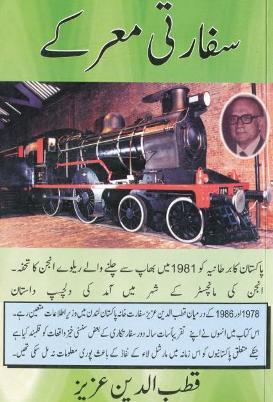 Image to the right shows the book cover.
In the following paragraphs I’ll try to narrate the story which Q. Aziz wrote in his book. He was secretary of information in Pakistan’s diplomatic mission to UK during 1978-1986.
In 1981 the director of Manchester Museum of Science and Industry, Dr. R.L. Hill came to the Embassy of Pakistan in London. His exact words to Q Aziz are hard to recall but basically he told him that:
Steam locomotives are fast becoming a thing of the past. People of Britain take lot of interest and pride in their preservation and consider it their national heritage. We’ve come to know that a steam locomotive which was built in 1911 at Vulcan Factory(near Manchester) is currently the property of Pakistan Railway. It is getting ready to be retired from service and will be sold as scrap metal after that. Can the Government of Pakistan give this locomotive as a gift to the museum? The museum will display this locomotive all year round and the new generation of Britain which is not familiar with Steam locomotives will learn about their glorious past.
Dr. Hill also told Q. Aziz that South Africa and India also have British made Steam locomotive but both countries want to keep these locos in their own countries. Since Pakistan is moving fast towards Dieselization therefore steam technology will soon become archaic there and Manchester Museum would like to preserve this steam locomotive for everyone’s benefit. Mr. Hill also offered to bring the locomotive to UK aboard a ship and sponsor its transportation.
While talking to the Q. Aziz, Dr. Hill gave more details of the steam locomotive as:
it was built in 1911 at Vulcan Factory and the same year it was shipped to Mumbai (then Bombay) where it remained in service with G.I.P Railway. The locomotive did great service duringWorld War I and II where it was used to move thousands of troops from one place to other. This locomotive had seen every nook and corner of India. In 1947, this locomotive was given to Pakistan Railway where it continued to serve the passengers for more than 30 years and was now on the verge of retirement. It was estimated that if sold as scrap metal, the locomotive would’ve fetched upto Rupees 500,000. If Government of Pakistan could donate it to the museum then it would be great for coming generations.
Pakistan’s Federal Secretary of Communications, Lt Gen Mujeeb-ur-Rehman was visiting London in 1981. Q. Aziz told him to ask Pakistani Government to give this locomotive to UK. This was the time when USSR had invaded Afghanistan and Pakistan badly needed support of USA, UK and other Western Countries. Margaret Thatcher was already against USSR’s invasion and at such time a donation like this to Manchester Museum could certainly create good will for Pakistan along with preserving the locomotive’s historical value.

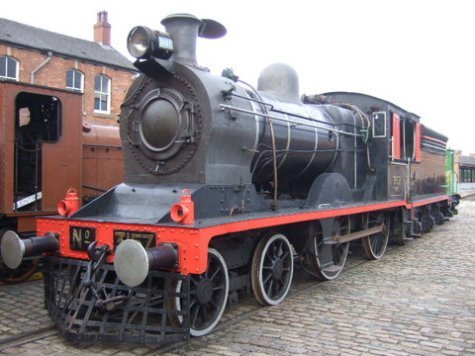
The photo above shows how #3157 looked like before it was ready to be retired. Seen here at Moghalpura Workshops in 1981.
Few days later the then President of Pakistan, Gen Zia-ul-Haq asked Pakistan Railway Board to look into the merits of donating the loco to Manchester museum as well as to get its scrap value appraised. The appraised value came out to be around Rupees 500,000 and the Railway Board decided to donate the locomotive to Manchester Museum.
Embassy of Pakistan in UK in the mean time announced the decision of Government of Pakistan to donate the locomotive to Dr. Hill who thanked Pakistan on behalf of Manchester Museum. Sir Fredrick Bent who was the then President of Pakistan Society (UK) and a member of Parliament in UK called this a landmark decision in the relationship of UK and Pakistan. British press also gave due coverage to this announcement and several stories were carried out in the press. Embassy of Pakistan also issued an old photo of the loco to the press.
The locomotive was then sent to Moghalpura workshops in Lahore where it was rehabilitated including a new coat of paint. The embassy was told the locomotive was in running condition and as a test it was successfully driven on a long route in Baluchistan.
Dr. Hill told Q. Aziz that his museum was working with a shipping company called ‘P&O’ to transport the locomotive from Karachi to Liverpool when one day suddenly the company closed its service to Karachi.
Dr. Hill became very sad and came to Q.Aziz and told him the story. Few days later the then CEO of Pakistan National Shipping Corporation (PNSC) Rear Admiral Bhombhal came to London. In the meantime embassy people found out that possible freight of transporting the loco from Karachi to Liverpool via ship could cost as much as ten thousand pound sterlings. Q. Aziz talked to Bhombhal who told him that since this is a good cause, PNSC will bring the loco from Karachi to Liverpool free of charge. When President of Pakistan heard about this gesture of PNSC, he became happy and himself went to see the locomotive after its rehabilitation was completed at Moghalpura Workshops. A farewell party was arranged to see off the locomotive from Lahore. Black paint was done on with a coat of wax (polish) to make it look shiny.
The book claims that:
“The locomotive was then brought from Lahore to Karachi (a distance of 1220 km) on its own locomotion. Coal and Water were especially made available for the loco enroute.”
I am unable to verify this claim by any other source. Most likely the locomotive was dragged from Lahore to Karachi either as dead weight behind another loco or in ‘light steam’. This was probably done to avoid any untoward damage to the loco before it was to be sent to UK. One of my friends Nick Lera has told me in an email message that # 3157 definitely ran under its own steam into the Karachi docks and right up to the quay before embarkation. Therefore we can say for sure that the loco covered atleast some part of its long journey on its own power.
Big cranes at Karachi port lifted the locomotive and put it on the deck of a PNSC ship. Pegs were inserted on the deck and ropes were used to make sure engine does not move during sea journey’s turbulations. 3 weeks later, the ship arrived at the port of Liverpool. Dr. Hill was waiting for this arrival impatiently because he had told the Buckingham Palace about the locomotive’s arrival and he wanted to get an appointment with the queen after knowing the date of engine’s arrival at Manchester with some surity.
The PNSC ship docked at Liverpool in the evening and Dr. Hill called Q. Aziz to invite him to the port next day so he could also watch locomotive’s unloading from the ship. Q.Aziz wanted to go to the port too but next morning Dr. Hill called him again and asked not to come to Liverpool yet. He told Q. Aziz that British Customs had come to know that a large amount of narcotics (heroin) were hidden in the locomotive. Customs was therefore planning to inspect the whole engine with drug smelling canines at 10:00 a.m. and then decide on its future. Around 6 p.m Dr. Hill called Q. Aziz again and told him that Customs looked at every inch of the locomotive and no narcotics were found. Customs cooperated with the embassy and this news was not given to the press. Q. Aziz also didn’t tell this news to anyone - not even to the then President of Pakistan - because he thought it was probably done to malign Pakistani Government by some bad wisher. The news bacame public in 1989 with the publication of this book.
This locomotive then travelled by road on two loaders to Manchester. One loader was used for the engine and other for the tender. The locomotive was then parked in Manchester museum using an electromotive which pushed # 3157 to its permanent place in its new home.
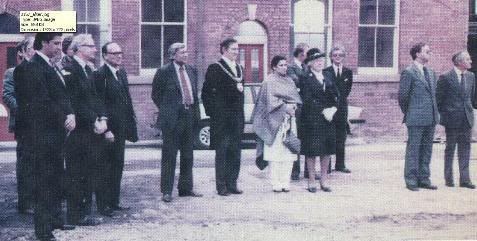
Dr. Hill was then given a date from the Queen about when she could come to Manchester and receive the locomotive on behalf of British people. The day finally arrived. Queen and Prince Philip came from the Royal family. Pakistan’s ambassador and PNSC’s CEO were also present. See the photo below from this occasion. News was carried on both TV and Radio. London Times also printed a large photo of the locomotive the next day.
The author here narrates an interesting anecdote:
During the reception Prince Philip asked Dr. Hill whether the engine was in working condition. At this question, Dr. Hill looked towards Q. Aziz and told Prince Philip that engine had arrived from Liverpool to Manchester on its own and is in working condition”.
This is one place in this article which creates some doubts to the mind with the Urdu words ‘apne bal-boote par’ which mean ‘on its own’ . The fact is that locomotive had come from Liverpool to Manchester by road and not on its own. Therefore I don’t know whether Dr. Hill used a metaphor for Prince Philip or the author has recalled the conversation wrong. The book was written 8 years after the event took place therefore recalling events and words does become doubtful - when it comes to details.
The author further writes that after hearing Dr. Hill’s reply, Prince Philip said:
“Yes, since our people built this engine therefore it is still working”.
To this Q. Aziz replied:
“Your excellency, please don’t forget that Pakistan has maintained the engine for all these years and has now given it to UK in running condition”
This locomotive is now 99 years old. Next year will be its centennary celebrations. It continues to be on display at Manchester Museum with a grandeur unmatched by its other colleagues.

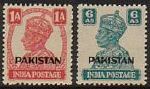
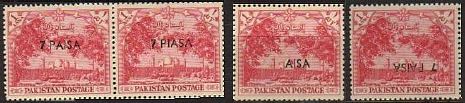
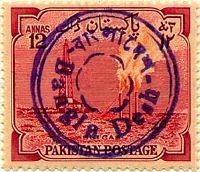 most boring were from the Middle East. But anyways, I wanted to write today about the early stamps of Pakistan. I will follow up with a post on the early currency notes from Pakistan, which happened to be my brother’s hobby.
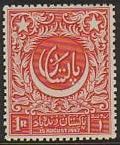 It wasn’t until July 1948, that the first set of entirely Pakistani stamps were printed. Shown is the picture of the first 1 Rupee stamp of Pakistan. The stamp has a beautiful floral pattern with thechand and stitara motif, and an Urdu inscription reading Pakistan Zindabad, i.e. Long Live Pakistan. Some would call this the first official stamp of Pakistan.
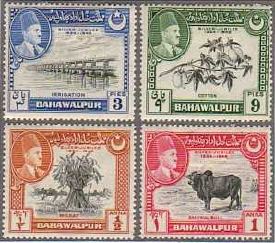 The photo on the [left] shows a set of four stamps issued in 1949. These stamps were beautifully engraved and shows industrial symbols of Bahawalpur: irrigation barrage, wheat, cotton, and local bullock. About 60 Bahawalpur stamps were issued and all of them are in high quality, reflecting the hobby of the state’s ruler (he himself was an enthusiastic philatelist).
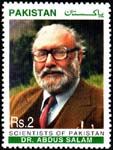 Since 1947, Pakistan has been printing stamps regularly, and according to one catalogue over 750 stamps were printed between 1947 and 1990. These stamps have been of various categories: service stamps (used by government agencies to mail material), regular stamps, and commemorative stamps.
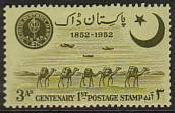 In 1952, the Pakistan Postal Service issued an interesting commemorative stamp on the 100th anniversary of the oldest stamp in Asia. The original was called the “Scinde Dak” and was used in Karachi and surrounding regions in Sind. The centenar stamp was for 3 anas and shows the camel caravans that were used to carry the early mail.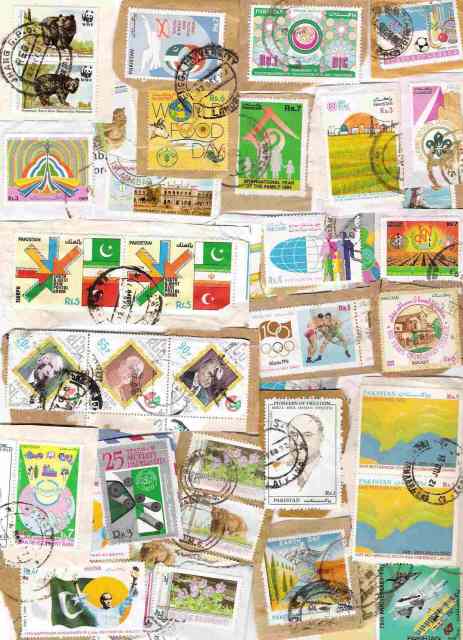
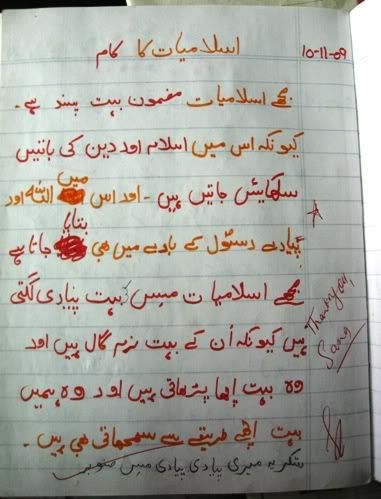 Few days ago my brother who is in class two, was ahowing me his school work. As I was going through his notebook I found following text on the first page. I started reading it and as I reached the bottom half of the page, it floored me with laughter. For our English readership: The first four lines of the text talk about the religion and the God but from 5th line onwards the text goes like this.