 Violent crimes have been at historic up nationwide; they are rising sharply in all cities. The rise seems to have been set off by something more bewildering.
Imagine Lahore only ten years ago: It was a different city; socially cohesive, closely knit. Young children could go visiting neighbors or to nearby shopping centers to get groceries and other things but not now. People then knew each other personally and had strong social bounds; hence courtesies for each other.
Things started changing with an exponential increase in urbanization. Large number of outsiders started moving in Lahore to live and or work. Now even the immediate neighbors do not know each other and people act like total strangers. Garish housing societies have come up on all the open spaces inside the city and Lahore has expanded much beyond what used to be municipal boundaries. The crime rate has grown with mush faster speed than the city.
What are the apparent causes? Many experts say that crimes are a result of disintegrating familial and dwindling community values that are contributing in turning young people into violent criminals.
Due to the growing demand for educated workforce and skilled labor, an employment base that used to provide jobs for those without a school certificate has shrunk considerably. This situation has resulted in a general lack of hope. “If one does not have skills, training, and when socio economic situation looks desperate, does that young man really have hope? I think that ties into the anger,” says a sociologist Dr. Muhammad Anwar, “This anger seem to be translating in to crimes, petty in the beginning that leads to more heinous ones at later stages.” This is the reasons that the criminals mostly are in their mid teens to mid-20’s.
 One finds unskilled workers sitting in a linear fashion with their tools - mountains of paint brushes, piles of colour scheme cards, number of empty paint cans, digging paraphernalia and or hammers of different kind (who said unskilled labour) - along any city roads and squares waiting for a day’s job. They all come from suburbs to earn their livings. What options do they have when they do not get the job for the day and they have to go back home to family that is to b fed, is the question. They not only lose hope but may get frustrated that may lead them to resort to unfair means, what ever is possible for them.
Similarly, the army of maids and home servants who come from nearby villages and towns when dazzled by urban glamour are incited to commit to petty crimes and thefts.
Not only unskilled and uneducated segment, even degree holders find it difficult to get their first job after graduation because traditionally the job market in slow economy of Pakistan has always been tight. Which is why one reads reports of crimes (from purse and mobile phone snatching to car lifting to burglaries and murders) being committed by people from effluent class and living in posh localities of Lahore? Though generally, the poorer neighborhoods are considered to be the hubs for frequent criminal happenings. Let me hasten to add, this does not imply that there are no crimes in posh localities like Defense Society, or Gulberg or the criminals living in these localities can not commit crime around Railway Station or Badami Bagh Bus Terminal or Lakshmi or Bhatti gate.
Besides hopelessness, crimes are attributed to greed, to an evil nature, to poor parenting, to television, to movies, to the Internet, to whatever seems to be popular and not in accord with our old societal value system. These and many other are the reasons that we find crime rate rising on an alarming rate.
Crime statistics, like any other officially reported data, cannot be considered reliable. In the past decade, Lahore has been awash with guns. Empirical evidences tell that Kalashnikov and other automatic weapons have become ubiquitous in Lahore, city called cultural capital of Pakistan. This fact makes the crime quick and fast, much faster than law enforcing agencies to track.
Criminality extends into all levels of society and it cannot be restricted to the largely undefined boundaries of Lahore. Given the fast and efficient communication means (roads network, mobile phones, more transport), it has been observed that criminals sometime come from suburbs, make their day and go back uncaught. Those who study crime debate say, “Criminals may be from anywhere but all crime is local, of course, and each city has its underlying causes.”
Analyzing crime is an absorbing exercise. It throws up new facets of crime and new ideas on how to cope with them. The real tragedy, however, is that there is hardly a national debate on crime, like the one seen in the developed world; where the crime are more. “Unless crime hits hard personally, I am not concerned,” is the worst attitude that is exhibited some time.
The only long term solution to put an end to crimes and make our society more civilized is to end hopelessness. How to create hope in the people and tolerance in our society are the real issues that need to be addressed. And this can happen when every one is conscious and does what ever is possible.
The solution is not with police or any other law enforcing agencies. “The problem is much deeper and the solution has to be long term. Combating crime firmly and honestly is one thing. Provision of education, heath and other social securities, fair play in practices and procedure are some other starting points. Collectively, we should act responsibly and are some factors to start if we have to combat crime,” Dr. Pirzada Inam Karim.

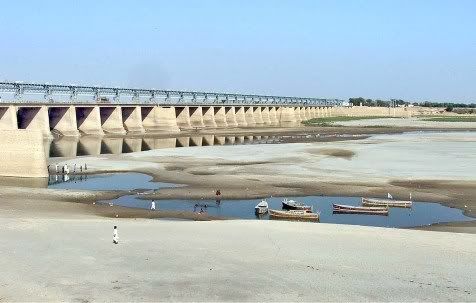
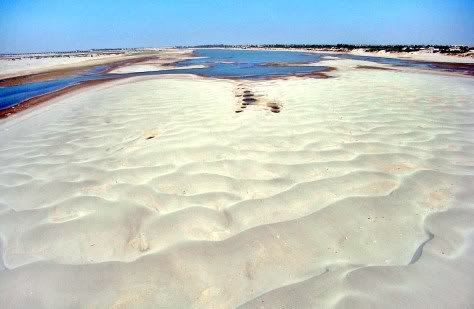
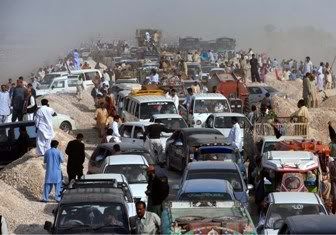 Therefore it was not very surprising to see the unanimous support ‘Indus River Day’ received in Sindh province on Jan 24, 2009. It was not covered widely by the National Press but few photographs that I’ve seen from the event showed the passion with which people in Sindh consider this to be an issue which is very close to them.
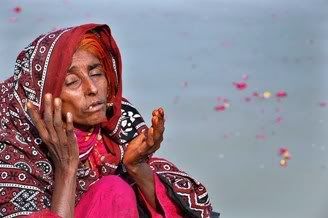 The photo to the right shows an old timer praying at the banks of Indus in Larkana on the occasion of Indus River day.
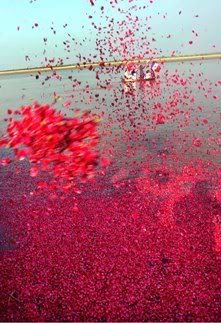 The photo to the left shows rose petals being thrown into Indus waters as a gesture of thanks and prayers to the river water which supports life and economy of many here.